Token-Efficient AI Agents: Architecture, Prompts, RAG Design — and When Opus Becomes Cheaper Than Sonnet
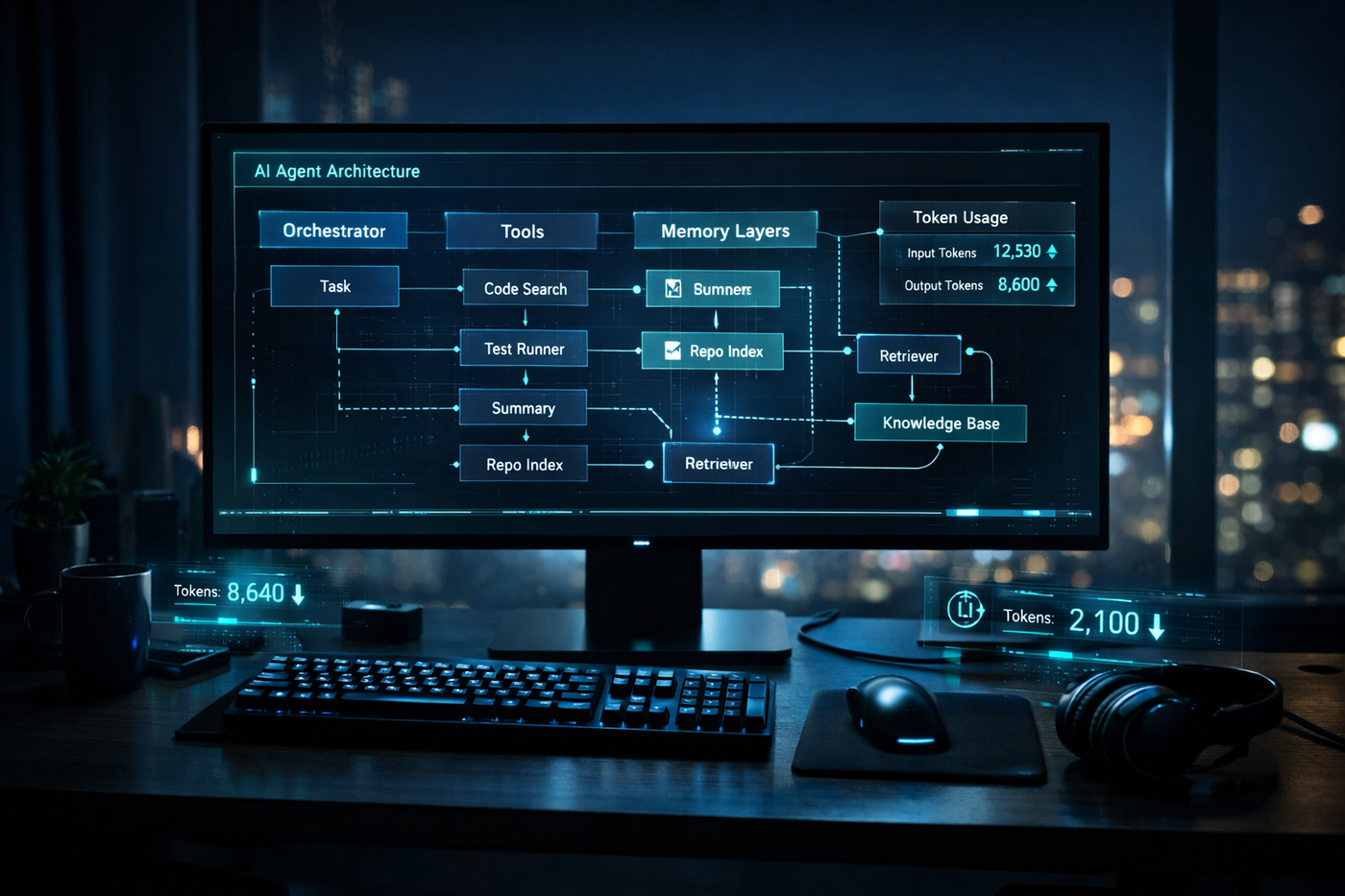
AI coding agents are powerful — but they can burn tokens fast.
If you’re building developer tools, automation workflows, or platforms like Daily Drift Hub, token efficiency isn’t optional. It directly impacts cost, speed, and scalability.
In this guide you’ll learn:
- A token-efficient agent architecture used in production
- Copy-paste Claude Code prompts that reduce token usage
- A RAG design that prevents context bloat
- The exact moment Opus becomes cheaper than Sonnet
Why Token Efficiency Matters
Most developers assume model choice drives cost.
In reality:
Token cost = context size × loops
The biggest token killers are:
- Sending full files repeatedly
- Long chat history
- Retry loops
- Context stuffing in RAG
- Verbose model outputs
Fixing architecture saves more than switching models.
Token-Efficient Agent Architecture
The most effective pattern is:
Thin orchestrator + thick tools
Instead of sending your whole codebase to the LLM, the orchestrator receives only:
• Task goal
• Small repo map
• Relevant snippets
• Current diff
• Failing error
Tools handle heavy work:
• Search (ripgrep, fd)
• Test runs
• Build checks
• Formatting
Changes are written as diffs, not full files.
This alone can cut token usage by 50%+.
The 3 Memory Layers Pattern
Replace long conversation history with structured memory.
1. Working Context (2–6k tokens)
Current task, error, diff.
2. Session Summary (300–600 tokens)
What was done, decisions, next step.
3. Repo Index (1–2k tokens)
Directory overview and module responsibilities.
When context grows, compress into the session summary and discard old turns.
Model Routing (Cheap by Default)
Use smaller models for exploration:
• Small / Haiku → search planning, summarization
• Sonnet → implementation
• Opus → hard bugs, refactors, architecture
Avoid spending premium tokens on file discovery.
Claude Code Prompt Template (Token-Saving)
Start sessions with a constraint-first prompt.
You are operating inside a repo. Optimize for MINIMUM tokens.

Rules:
- Don’t ask for the full file unless necessary. Request only the smallest relevant snippet.
- Prefer search over reading many files.
- Output MUST be: (1) Plan (max 5 bullets) (2) Patch diff (3) Commands to verify (max 5 lines).
- Do not include explanations unless asked.

Context you will receive:
- Goal
- Error output (last ~40 lines)
- Relevant snippets
- Existing diff

When uncertain:
Ask exactly one missing detail.
This reduces verbosity, retries, and unnecessary context requests.
Fix Failing Tests Template
Run tests.
For each failure:
1) Root cause in 1 sentence
2) Smallest safe change
3) Re-run minimal test command

Return only: diff + commands + final status.
This prevents explanation loops — a common token drain.
RAG Design That Reduces Tokens Massively
The biggest RAG mistake is context stuffing.
Instead of sending large documents, use:
Retrieval Budget
- Top-k: 4–8 chunks
- Chunk size: 200–500 tokens
- Remove duplicates
- Hard token cap (1.5k–3k)
Two-Stage RAG (Very Important)
Stage 1 — Cheap summarization
- Summarize candidate chunks into bullet facts.
Stage 2 — Precise context
- Send only best summaries
- Include raw text only when necessary
The model reads summaries instead of full documents.
Huge savings.
Cache Stable Prompts
Cache:
- System prompt
- Repo index
- Tool schema
- Style guide
This can cut 20–40% tokens.
When Opus Becomes Cheaper Than Sonnet
Many developers think Opus is always more expensive.
Not true.
Opus becomes cheaper when it finishes tasks with fewer tokens.
Using current pricing (approx):
- Sonnet: $3 input / $15 output per 1M tokens
- Opus: $5 input / $25 output per 1M tokens
Opus is cheaper if it uses roughly 40% fewer tokens than Sonnet.
Why this happens
Opus often:
- Avoids retries
- Produces correct patches faster
- Requires fewer clarifications
- Handles complex reasoning in one pass
So difficult tasks can be cheaper on Opus.
Practical Rule for Developers
Use:
- Sonnet for most coding
- Opus for complex bugs and refactors
- Small models for search and summarization
Architecture decisions matter more than model choice.
Key Takeaways
- Token cost is driven by loops, not model size
- Diff-first workflows drastically reduce usage
- Memory layers replace long chat history
- Two-stage RAG prevents context explosion
- Opus can be cheaper on hard tasks
If you design your agent architecture correctly, reducing token usage by 60–80% is realistic.
Final Thought
The future of AI development isn’t just better models — it’s better context design.
Teams that master token efficiency will ship faster, spend less, and scale AI workflows without cost surprises.
Related Posts

Useful Tools For This Topic
Explore all toolsJSON Formatter
Format, validate, and beautify JSON instantly.
JWT Decoder / Encoder
Decode payloads, verify signatures, test secrets, and generate JWT tokens.
Timestamp Converter
Convert between Unix timestamps and dates.
UUID Generator
Generate unique UUIDs for your applications.